
When revising for the UK driving theory test, some questions seem so basic that they can actually be the easiest to get wrong. One of the most common examples is: which colour follows the green signal at a puffin crossing? Many learner drivers pause on this question not because it is difficult, but because pedestrian crossings come in different types and are often confused with one another.
The correct answer is steady amber, but understanding why this is the case is just as important as memorising the answer itself. Puffin crossings operate differently from older systems, and the driving test is designed to check whether you understand how modern crossings work in real traffic situations. This guide explains the signal sequence clearly, shows how puffin crossings differ from others, and helps you avoid the mistakes that cause many learners to lose easy marks.
What a Puffin Crossing Is and Why It Exists
A puffin crossing is a modern type of signal-controlled pedestrian crossing used across the UK. The word “puffin” is an abbreviation for Pedestrian User-Friendly Intelligent, which reflects how the system is designed to respond to people actually using the crossing rather than relying only on fixed timings.
Unlike older crossings, puffin crossings use detection technology to monitor pedestrian movement. This means the crossing can hold traffic at red for longer if someone is still crossing, or return traffic to green sooner if no one is present. The goal is to improve safety for pedestrians while reducing unnecessary waiting time for drivers.
Another defining feature is the position of the pedestrian signals. At puffin crossings, the pedestrian indicator is usually placed on the same side of the road as the user. This allows pedestrians to keep their attention on nearby traffic rather than looking across the carriageway, which is particularly helpful for children, elderly users, and people with mobility or visual impairments.
How Puffin Crossing Traffic Lights Work for Drivers
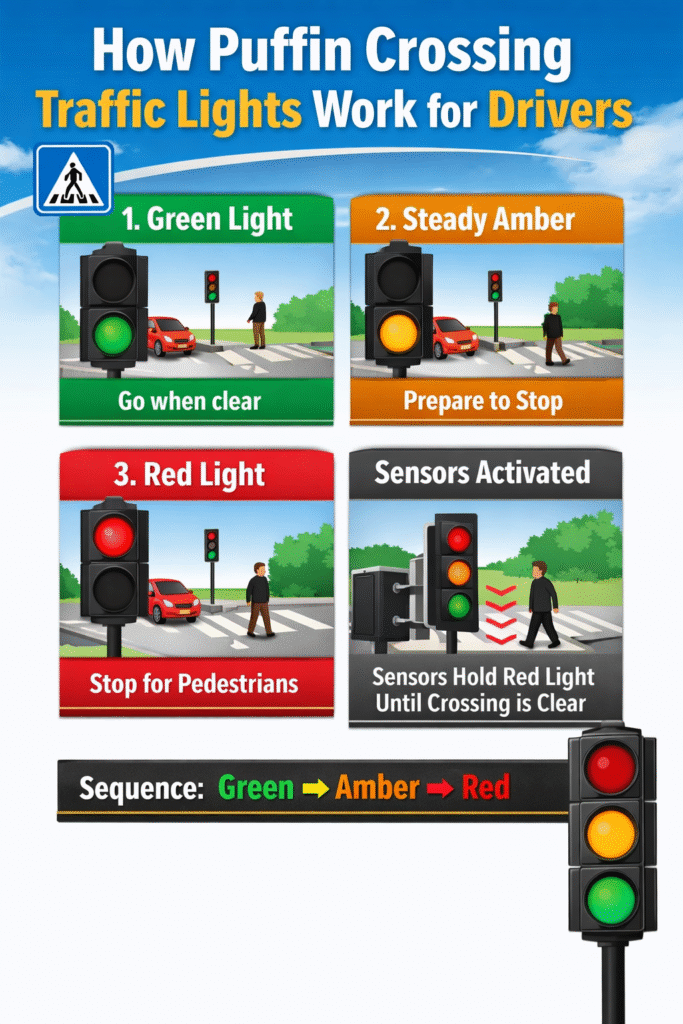
For drivers, puffin crossings follow a familiar traffic-light pattern. This is where many learners overthink the process and start looking for “special” signals that do not actually exist. From a driver’s point of view, the lights behave in a predictable and controlled way.
When traffic is stopped to allow pedestrians to cross, drivers will see a red signal. As the crossing prepares to return control to vehicles, the lights change through the standard UK sequence. This includes a short red-and-amber phase before green appears, just as at normal junctions. Once the green signal is shown, vehicles may proceed if the crossing is clear.
Crucially, when the green phase is about to end, the next signal shown to drivers is steady amber. This amber light warns that the signal is about to return to red and that drivers must prepare to stop unless they are too close to the stop line to do so safely.
Which Colour Follows the Green Signal at a Puffin Crossing?
To answer the theory test question directly and accurately: the colour that follows the green signal at a puffin crossing is steady amber.
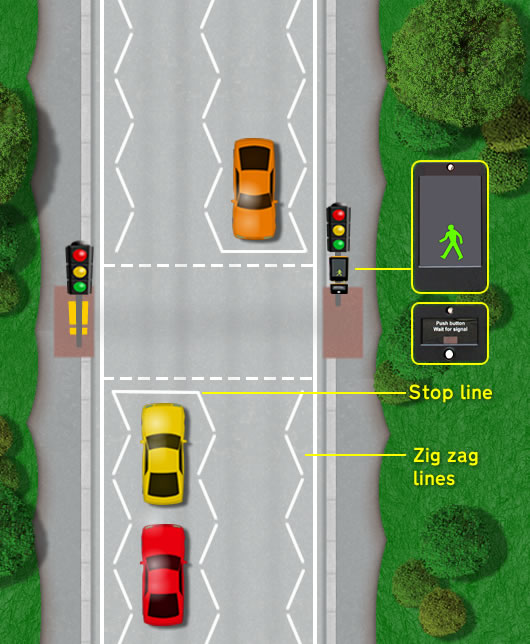
This amber light is not flashing and does not invite drivers to judge whether they can proceed through the crossing. Instead, it serves the same purpose as amber lights at other UK traffic signals. It gives drivers a short warning that the green phase is ending and that stopping is required unless doing so would be unsafe.
This is an important detail because many learners mistakenly associate pedestrian crossings with flashing amber lights. That assumption leads to incorrect answers in the theory test. Puffin crossings do not rely on a flashing amber phase for drivers after green, which is why steady amber is the correct and consistent answer.
Why Puffin Crossings Do Not Use a Flashing Amber Phase
The absence of a flashing amber phase is one of the most important differences between puffin crossings and older crossing types. Flashing amber signals require drivers to make a judgement call about whether pedestrians are still crossing, which can create uncertainty and risk.
Puffin crossings remove much of that uncertainty by using detection systems. These systems monitor whether pedestrians are still on the crossing and keep traffic stopped until the crossing area is clear. Because of this, there is no need to rely on drivers making decisions during a flashing signal.
As a result, puffin crossings use a simpler and more controlled sequence for vehicles. After green, drivers see steady amber, followed by red. This approach prioritises pedestrian safety while still maintaining predictable behaviour for motorists.
What Pedestrians Experience at a Puffin Crossing
Understanding the pedestrian side of a puffin crossing can make you a more aware and patient driver. Pedestrians activate the crossing using a push button and wait for a signal that tells them when it is safe to cross. The system can also provide audible and tactile feedback to assist users with disabilities.
While pedestrians are crossing, the detection technology monitors their movement. If someone is still on the crossing, traffic signals remain on red, even if the usual crossing time would otherwise have ended. This reduces the risk of vehicles moving off while pedestrians are still exposed.
For drivers, this means it is normal to wait slightly longer at a puffin crossing than at older types of crossings. Recognising this behaviour helps you respond calmly rather than assuming something has gone wrong with the lights.
How This Question Appears in the UK Driving Theory Test
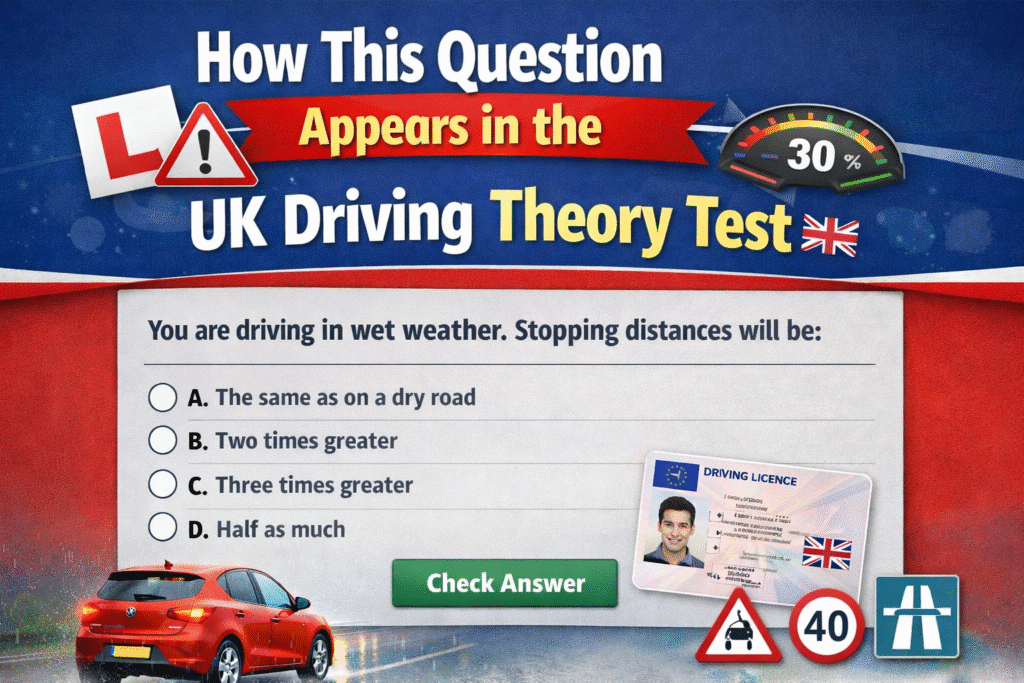
The theory test often uses simple wording to check whether learners truly understand traffic rules. The question which colour follows the green signal at a puffin crossing is designed to test your knowledge of signal order, not your ability to guess based on crossing names.
Common incorrect options include “flashing amber” or “flashing green”. These answers are included to catch learners who revise carelessly or confuse puffin crossings with pelican crossings. If you read the question carefully and focus on the word follows, the correct answer becomes much clearer.
A useful exam strategy is to visualise a standard set of traffic lights rather than focusing on the pedestrian aspect of the crossing. When you picture green changing to amber, the correct choice stands out immediately.
Puffin Crossings Compared with Other Pedestrian Crossings
Learner drivers often mix up different crossing types because they share similar features. However, puffin crossings are distinct in both design and operation. Pelican crossings, for example, are older systems that may include flashing signals and rely more on fixed timings.
Toucan crossings allow both pedestrians and cyclists to cross together and follow a similar controlled traffic-light sequence to puffin crossings. Zebra crossings, by contrast, rely on driver observation rather than traffic signals.
By understanding that puffin crossings are sensor-controlled and designed to reduce driver judgement during transitions, it becomes easier to remember why the signal sequence remains straightforward and why steady amber follows green.
Common Errors Learner Drivers Make
One of the most frequent mistakes is assuming that all pedestrian crossings behave the same way. This leads learners to answer based on what they remember about flashing amber signals rather than on the specific crossing named in the question.
Another common error is misreading the question itself. Some learners instinctively think about what follows red rather than what follows green. In a timed exam, that single misunderstanding can lead to an incorrect answer even if the learner understands traffic lights well.
To avoid these errors, slow down when reading the question and repeat it in your head. Ask yourself what happens immediately after green and ignore anything you know about other crossing types unless the question specifically mentions them.
Why Knowing This Matters Beyond the Theory Test
Although this question is often associated with the theory test, understanding puffin crossings has real-world benefits. As a driver, recognising the steady amber phase helps you anticipate stops smoothly and avoid harsh braking.
It also encourages patience around pedestrian crossings. Knowing that puffin crossings are designed to protect pedestrians until they are fully clear can reduce frustration and promote safer behaviour, especially in busy urban areas.
Driving is not only about passing tests; it is about developing habits that keep everyone safe. Clear knowledge of how crossings work supports that goal.
Key Takeaways for Revision
The colour that follows the green signal at a puffin crossing is steady amber.
Puffin crossings use detection technology, which removes the need for flashing amber signals.
For drivers, the light sequence follows standard UK traffic-light rules.
Careful reading of the question is often the difference between a correct and incorrect answer.
Frequently Asked Questions
What does steady amber mean at a puffin crossing?
It warns that the green phase is ending. Drivers must stop unless they are too close to the stop line to do so safely.
Does a puffin crossing ever show flashing amber to drivers?
No. Puffin crossings rely on detection systems and use steady amber rather than flashing amber after green.
Is this question common in the UK theory test?
Yes. It regularly appears because it tests understanding rather than memorisation.
What is the full driver light sequence at a puffin crossing?
For drivers, the sequence follows standard traffic-light order: red, red and amber, green, steady amber, then red.
How can I remember the correct answer in the exam?
Think of puffin crossings as controlled and predictable. After green, the next colour is always steady amber.
You may also read: Which Magazine: Trusted UK Reviews for Smarter Buying Decisions