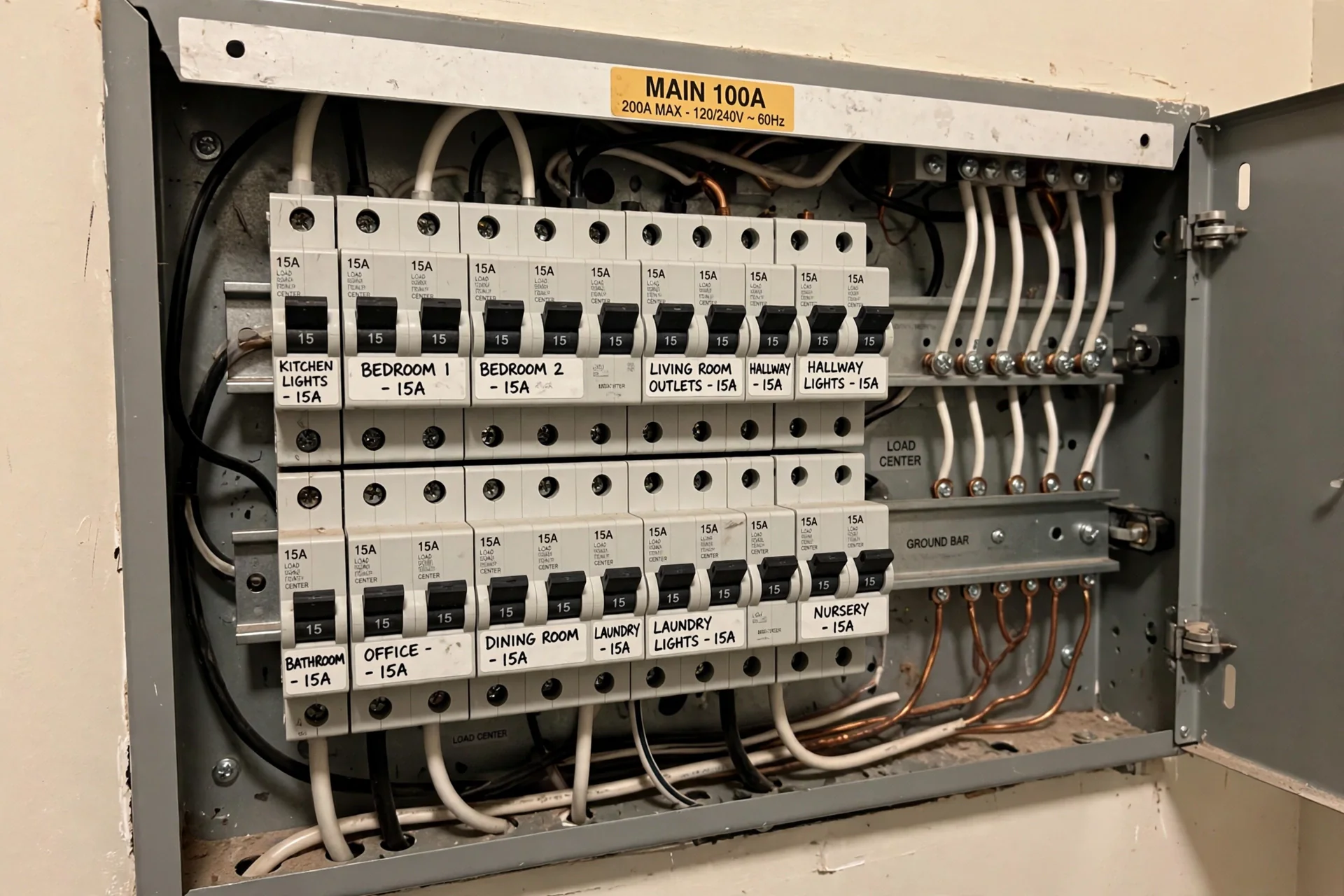
The question of how many lights on a 15 amp circuit you can safely install comes up in almost every home lighting project, from a simple bedroom refit to a full renovation with dozens of recessed fixtures. It sounds like it should have a single-number answer, but the real answer depends on wattage, voltage, bulb technology, and the safety margins written into electrical codes. Getting it wrong does not just mean a tripped breaker; an overloaded circuit can overheat wiring hidden inside your walls, and that is a genuine fire risk no homeowner should gamble with.
The good news is that the calculation itself is straightforward once you know the rules. A 15 amp circuit on a standard 120-volt supply has a theoretical maximum of 1,800 watts, but electrical codes require continuous loads to stay at eighty percent of that figure, giving you a safe working budget of about 1,440 watts. Divide that budget by the wattage of each fixture and you have your answer. This guide walks through the NEC 80 percent rule, the huge difference LED bulbs make, and the common mistakes that push circuits past their safe limits.
Understanding What a 15 Amp Circuit Means in Home Wiring
A 15 amp circuit is the workhorse of residential electrical systems, and it is the circuit most of your home’s lighting runs on. It is protected by a 15 amp breaker in the consumer unit or panel, wired with cable sized to carry that current safely, and in most countries it operates at the standard residential voltage. The breaker’s job is simple and vital: the instant current exceeds the safe rating, it trips and cuts power before the wiring can overheat, which is why a frequently tripping breaker should be treated as a warning rather than an annoyance.
These circuits are designed for lighting and light-duty outlets, not for heavy appliances, which is a distinction that matters when you start adding up loads. Bedrooms, hallways, living rooms, and dining areas typically run their ceiling lights, wall sconces, and general outlets from 15 amp circuits, while kitchens, bathrooms, workshops, and laundry areas use higher-rated circuits for their heavier demands. When you ask how many lights on a 15 amp circuit, you are really asking how much of that circuit’s safe wattage budget the lighting will consume, leaving room for everything else sharing the wire.
NEC Rules and the 80 Percent Safety Rule
The National Electrical Code’s 80 percent rule is the cornerstone of safe circuit design, and it exists because electrical systems behave differently under sustained load than in brief bursts. A circuit loaded to its absolute maximum generates heat in the wiring, and while a short spike is harmless, hours of maximum load let that heat accumulate in conductors, connections, and breaker terminals. The eighty percent limit keeps continuous loads comfortably inside the thermal safety margin, which is why electricians treat it as mandatory for lighting circuits that may run for hours every evening.
The arithmetic is simple: fifteen amps multiplied by 120 volts gives 1,800 watts of theoretical capacity, and eighty percent of that is 1,440 watts of safe continuous load. That 1,440-watt figure is the number every other calculation in this guide flows from, so it is worth memorizing. Guidance from safety organizations such as the Electrical Safety Foundation International reinforces the same principle from the protection angle: circuits, breakers, and wiring must always be kept within their rated limits, because overloads are among the most preventable causes of electrical fires in homes.

Real-World Answer: LEDs Versus Incandescent Bulbs
Bulb technology changes how many lights on a 15 amp circuit you can run more dramatically than any other single factor, because it changes the wattage each fixture draws. A modern LED bulb producing the same brightness as an old 60-watt incandescent typically draws only eight to twelve watts, which means the same 1,440-watt safe budget that supports about twenty incandescent bulbs can support well over one hundred LEDs. In practical terms, a whole house worth of LED lighting will rarely strain a single 15 amp circuit, while a single room of old-style bulbs plus a few extras can push it surprisingly close to the limit.
With incandescent or halogen bulbs, the math is far tighter and deserves respect. At sixty watts each, 1,440 safe watts allow twenty-four bulbs; at seventy-five watts each, only about nineteen. Add a ceiling fan drawing seventy watts, a television on the same circuit’s outlets, or a phone charger bank, and the headroom shrinks fast. This is the main reason electricians now treat LED conversion as the first recommendation whenever a customer asks about expanding lighting on an existing circuit: it multiplies capacity without touching a single wire.
Why Wattage Matters More Than Fixture Count
The most persistent misunderstanding about how many lights on a 15 amp circuit is the idea that there is a fixed legal number of fixtures per circuit. There is not, and fixture-count rules of thumb are unreliable precisely because two fixtures that look similar can draw wildly different power. A decorative chandelier with twelve LED candles might draw twenty watts total, while a single old recessed can with a halogen lamp can draw ninety, so counting fixtures without checking wattage is like budgeting by counting shopping bags instead of reading receipts.
Professional load planning therefore starts from the nameplate wattage of every device on the circuit, not just the lights. Outlets on the same circuit may feed televisions, chargers, fans, or space heaters, and each one eats into the same 1,440-watt budget. Electricians also leave a comfort margin below even the eighty percent line for circuits that serve mixed loads, because real life includes vacuum cleaners plugged into bedroom outlets and guests charging laptops. Calculating from wattage and keeping a buffer is what separates a circuit that runs silently for decades from one that trips every movie night.
Comparing 15 Amp Circuits With Higher Capacity Options
It helps to put the 15 amp circuit in context against its bigger siblings, because the comparison clarifies when an upgrade is genuinely needed. A 20 amp circuit at 120 volts offers 2,400 watts theoretical and 1,920 watts at the eighty percent rule, roughly a third more headroom, which is why kitchens, bathrooms, and workshops are wired for twenty amps. Higher ratings like thirty, forty, or fifty amps serve dedicated heavy loads such as cookers, dryers, and EV chargers, and they follow the same proportional logic with heavier cable to match.
For pure lighting, though, bigger is rarely better as a solution, because the constraint is almost never the circuit rating once LEDs are in play. If your lighting plan genuinely exceeds 1,440 watts of LED load, you are describing a very large property or a commercial-style installation, and the correct answer is usually a second lighting circuit rather than upsizing the first. Splitting loads across circuits also adds resilience: a fault on one circuit leaves the other side of the house lit. Design for distribution, not just capacity.
Common Mistakes Homeowners Make With Circuit Loads
The classic mistake when working out how many lights on a 15 amp circuit is treating all bulbs as interchangeable, and it is the error behind most overloaded lighting circuits in older homes. Someone replaces half their incandescents with LEDs, assumes the circuit now has enormous spare capacity, and adds a dozen new recessed cans without doing the wattage math, forgetting that the remaining old bulbs and the new fixtures still share one budget. Always total the actual watts on the circuit as it stands today before adding anything new.
The second classic mistake is ignoring everything else already connected to the circuit, because lighting circuits in real houses are rarely lighting-only. That bedroom circuit also feeds the outlets where the phone chargers, television, and occasional space heater live, and a space heater alone can draw 1,500 watts, instantly exceeding the entire safe budget by itself. Map the circuit first: switch off the breaker and see what goes dark and what stops working, then add up the real loads. Five minutes with a notepad prevents the most common overloads entirely.
Frequently Asked Questions
How many LED lights can I run on a 15 amp circuit? Using the 1,440-watt safe budget and typical LED bulbs of eight to twelve watts each, a 15 amp circuit can safely support roughly 120 to 180 LED bulbs. In practice, other devices sharing the circuit and the desire for a safety margin bring the sensible number down, but LED lighting alone will almost never overload a 15 amp circuit.
What is the maximum safe wattage for a 15 amp circuit? The safe continuous load is about 1,440 watts, which is eighty percent of the 1,800-watt theoretical maximum at 120 volts, following the NEC 80 percent rule. Brief loads can approach the full rating, but anything running for three hours or more should stay within the 1,440-watt budget.
Can I mix lights and outlets on the same 15 amp circuit? Yes, and most homes are wired exactly this way, but the combined wattage of lights plus everything plugged into the outlets must stay within the safe budget. Be especially careful with high-draw plug-in devices like space heaters, hair dryers, and irons, which can single-handedly exceed the circuit’s safe capacity.
What happens if I put too many lights on the circuit? The breaker will trip, cutting power to protect the wiring from overheating. Occasional trips are a warning to reduce the load; if a breaker trips repeatedly, stop resetting it and have an electrician investigate, because persistent overloading can damage connections and create fire hazards.
How many 60-watt incandescent bulbs fit on a 15 amp circuit? Twenty-four at the absolute 1,440-watt safe limit, and fewer in practice once other loads and a comfort margin are accounted for. This tight budget is exactly why upgrading to LEDs, at eight to twelve watts each, is the standard recommendation before expanding lighting on an existing circuit.
Conclusion
How many lights on a 15 amp circuit ultimately comes down to one number and one rule: a safe budget of about 1,440 watts, governed by the eighty percent rule, divided by the actual wattage of your fixtures. With modern LED bulbs that budget stretches across more than a hundred lights, making overloads rare; with old incandescent or halogen bulbs it covers only fourteen to twenty-four, making careful planning essential. Wattage, not fixture count, is the quantity that matters.
Apply the method every time: total the watts of everything on the circuit, keep continuous loads under 1,440 watts, leave a margin for the unexpected, and treat a tripping breaker as a message rather than a nuisance. For homeowners managing different household energy needs, understanding the role of utility providers such as Atlanta Gas Light can also help put electricity usage into perspective when planning overall household energy expenses.
Planning outdoor lighting too? Our step-by-step guide to landscape lighting installation covers layout, transformers, and wiring basics.
For garden and pathway projects, see how to install landscape lighting before you buy your first fixture.