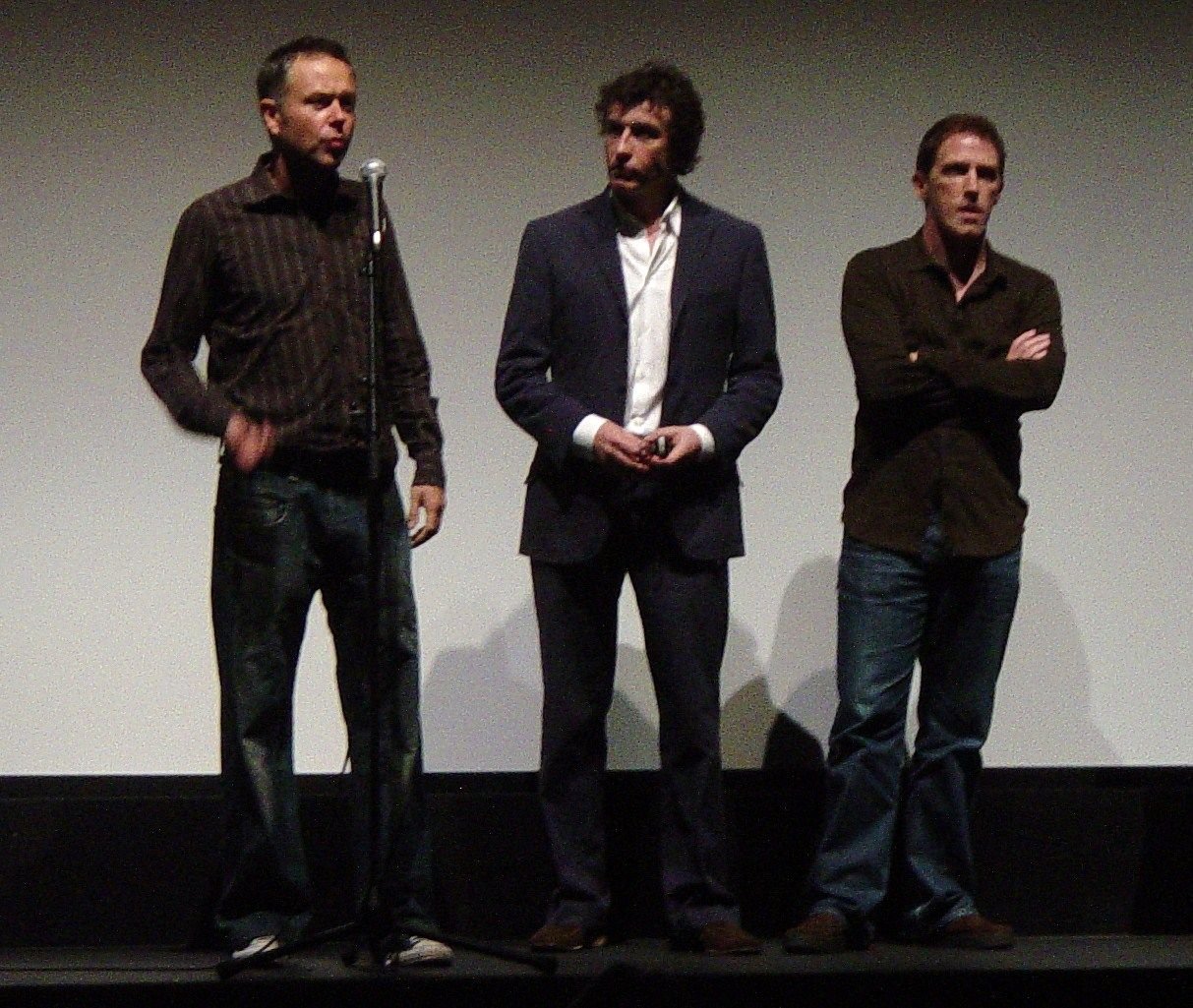
Steve Coogan and Rob Brydon were both born in 1965, five months apart, and both made their names doing other people’s voices. Coogan was born in October, Brydon in May, and for twenty years they moved in the same circles without ever quite becoming a double act. Then, in 2010, the BBC sent them on a restaurant tour of northern England, pointed a camera at them, and let them talk. The result was The Trip, a series so funny and so quietly revealing that it ran for four series across a decade, took them to Italy, Spain and Greece, and turned two solo comics into one of the great partnerships in British comedy.
The boy from Middleton who became Alan Partridge
Stephen John Coogan was born on 14 October 1965 in Middleton, Lancashire. His mother was Irish, from County Mayo, and his father worked as an engineer for IBM. He grew up in a large Catholic family in a mill town outside Manchester, and from an early age he was the boy who could do the voices. He trained at the Manchester Polytechnic School of Theatre, and when he left he worked the circuit as an impressionist: voiceovers, adverts and stand-up, while he waited for a break.
The break came from radio. Coogan began as a voice artist on the satirical puppet show Spitting Image. In 1991 he joined Radio 4’s On the Hour, the spoof news programme made with Armando Iannucci, and there he created the character who would define his life: Alan Partridge, a sports reporter with large opinions and no self-awareness. Partridge moved to television in The Day Today in 1994, then to his own sitcom, I’m Alan Partridge (1997–2002). In between, Coogan won the Perrier Award at the Edinburgh Fringe in 1992, the prize that announced a new star.
Partridge could have swallowed him whole. Plenty of comics have been trapped inside one character, and for years it looked as though Coogan might be one of them. Instead he built an escape route. In 1999 he co-founded Baby Cow Productions with Henry Normal, giving himself a company of his own. And he began, film by film, to show that he could act as well as mimic: Marie Antoinette in 2006, What Maisie Knew in 2012, The Look of Love in 2013. The proof came with Philomena in 2013, which he co-wrote, produced and starred in opposite Judi Dench. It brought him Oscar nominations for Best Adapted Screenplay and Best Picture, in a career that has now won six BAFTA Awards, with nominations for two Academy Awards and a Golden Globe.
The Welshman who became Uncle Bryn
Robert Brydon Jones was born on 3 May 1965 in Baglan, Port Talbot, in south Wales. Like Coogan, he was a mimic before he was anything else, and found his way into performing through youth theatre: it was at the Porthcawl Comprehensive School youth theatre that he met Ruth Jones, the writer and actor who would become one of his closest collaborators. At twenty he was a disc jockey on Radio Wales. He was an impressionist first and an actor second, and for years that was how Britain knew him.
His breakthrough came in character comedy. Human Remains, made with Julia Davis in 2000, showed he could be dark as well as funny. Marion and Geoff (2000–2003) gave him his first great creation: Keith Barret, a deluded taxi driver talking to a camera about a life falling apart. The Keith Barret Show followed in 2004 and 2005. Brydon was building a gallery of men who believed they were more impressive than they were, played with a sympathy that made the joke land twice as hard.
Then came the part that made him a household name. Gavin and Stacey, which ran from 2007 to 2010 with specials in the years after, cast him as Uncle Bryn, the warm, anxious Welsh uncle at the heart of the show. It earned him a BAFTA nomination for Best Comedy Performance in 2009, and when the show returned for its final episode on Christmas Day 2024, Bryn was still there. In 2009 he took over as host of Would I Lie to You?, succeeding Angus Deayton, and has held the chair ever since. The Rob Brydon Show ran from 2010 to 2012, and film roles followed in Cinderella in 2015 and Barbie in 2023.
Two Winterbottom films first
Before The Trip, the two men had already shared a screen twice, both times under the director Michael Winterbottom. The first was 24 Hour Party People in 2002, Winterbottom’s history of Manchester’s Factory Records, in which Coogan played the label’s flamboyant co-founder Tony Wilson. The second was A Cock and Bull Story in 2005, Winterbottom’s adaptation of the supposedly unfilmable Tristram Shandy, in which Coogan and Brydon appeared as sparring, self-regarding versions of themselves, jockeying for status on a film set. It was a rehearsal for everything that followed.
The photograph that best captures them comes from that second film. It was taken in Toronto in September 2005, at a screening of A Cock and Bull Story, with Winterbottom between them. Coogan stands on one side, Brydon on the other, the director who would send them on the road together in the middle.
The Trip: six restaurants, two egos
The idea was simple, and it was Winterbottom’s. Coogan is commissioned by The Observer to tour restaurants in northern England, writing about the food. He plans to take his girlfriend, but she leaves him, so he invites Brydon instead: the only person he can think of who will be available, and the only person who will never turn down a free lunch. What follows, across six half-hour episodes first broadcast on BBC Two from 1 November 2010, is largely improvised. The two men drive, eat, argue, sing, and compete, and the competition is the engine of the show. The most famous set piece is the duelling Michael Caine impressions, each man doing the voice, each man insisting his is better, until the joke stops being about Caine at all.
The film version, cut from the same material, premiered at the Toronto International Film Festival in September 2010, before the television series had even aired. This was not a sitcom with a food theme. It was about two middle-aged men, one famous and miserable, the other less famous and content, measuring themselves against each other over six meals. Coogan’s Steve is the bigger star and the unhappier man, professionally stalled and personally adrift. Brydon’s Rob is the family man who seems to have worked out how to be happy, which only makes Coogan resent him more. The food is beautiful. The scenery is beautiful. The company is not.
Italy, Spain and Greece
It worked so well that they did it three more times. The Trip to Italy arrived in 2014, following the great Romantic poets on their Grand Tour, from Piedmont to Capri. The Trip to Spain followed in 2017, on Sky Atlantic. The Trip to Greece came in 2020, on Sky One. Each series ran to six episodes, each was re-edited into a film, and each time the formula held: two men, a hire car, good restaurants, and the slow revelation that the jokes are a way of not saying what they really think. Ten years, four series, twenty-four episodes, and the partnership never curdled.
Why the double act works
Part of the reason it works is that the two men are genuinely different comics. Coogan is the satirist, the man who built a career out of characters who say the unsayable: Partridge, Paul Calf, a gallery of confident idiots. Brydon is the warmer performer, the man who can make a deluded taxi driver or a fussy uncle into someone you would want at your table. Put them together and each one exposes the other. Coogan’s neediness is funnier next to Brydon’s contentment. Brydon’s small vanities are sharper next to Coogan’s large ones. Both are impressionists, which means both spent their youth listening to other people, and The Trip is what happens when two men who are very good at being other people are asked, at last, to be themselves.
It is also, quietly, a story about British comedy itself. Coogan and Brydon belong to the generation that came up through radio and stand-up in the late eighties and nineties, and learned their trade in small rooms before television found them. They are not a double act in the old sense: there is no straight man and no funny man, no script and no catchphrase. There is only a car, a table, and two men who cannot stop trying to impress each other. For more on two very different British stars sharing one screen, read our piece on Olivia Colman and Claire Foy. A decade after that first drive through the north, they are still the funniest company on television, and the saddest, and the truest.