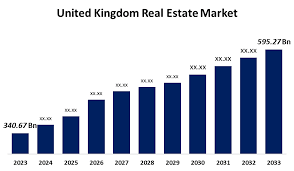
UK Real Estate Market Outlook 2025
The UK real estate market forecast for 2025 suggests a year of moderate but stable growth, supported by improving economic conditions and gradually easing inflation. House price growth is expected to remain in the range of 1% to 4%, reflecting a balanced market where demand and affordability are still in tension. Unlike previous boom cycles, the 2025 outlook is shaped more by stability than rapid expansion, with buyers and investors focusing on long-term value rather than short-term gains.
Overall market sentiment is expected to improve compared to previous years due to more predictable mortgage conditions and a gradual recovery in transaction volumes. However, affordability constraints continue to limit rapid price acceleration, especially for first-time buyers. The UK property market in 2025 is therefore best described as a steady adjustment phase, where regional differences and sector-specific performance play a much more important role than national averages.
Macroeconomic Drivers Shaping the 2025 Property Market
The broader economic environment plays a critical role in shaping the UK housing market forecast for 2025. Inflation is expected to continue easing, which helps stabilize household budgets and supports improved consumer confidence. At the same time, interest rates are projected to settle at more manageable levels, with mortgage rates averaging around the 4% range for fixed deals. This shift is important because borrowing costs remain one of the strongest influences on housing demand.
Government policy and long-term housing strategies are also expected to influence market direction. Efforts to increase housing supply, including a national target of building 1.5 million homes, are gradually improving availability in certain regions. However, structural supply shortages still exist in many high-demand areas. Combined with improving investor sentiment and stabilizing employment levels, these macroeconomic factors create a foundation for cautious but positive market performance in 2025.
Residential Property Market Forecast in the UK 2025
The residential property market in 2025 is expected to show steady but uneven growth across different buyer segments. While overall house price increases remain modest, demand is supported by long-term housing shortages and continued population growth in key urban areas. First-time buyers may still face affordability challenges, but improved mortgage conditions compared to previous years are likely to bring more activity back into the market.
Another key trend is the shift in buyer behavior, with more emphasis on affordability, energy efficiency, and long-term value. Properties that meet modern sustainability standards are likely to perform better in terms of price stability and resale potential. At the same time, older housing stock may experience slower appreciation unless upgraded. This creates a more segmented residential market where property condition and location matter more than ever before.
Regional UK Property Market Trends 2025
Regional performance is expected to vary significantly in the UK real estate market forecast for 2025. London is likely to experience slower price growth due to already high property values, which limit affordability for a large portion of buyers. However, the luxury property segment in the capital may continue to attract international investors, keeping that segment relatively stable even in a slower growth environment.
In contrast, regions such as the North West, Yorkshire, and parts of the Midlands are expected to outperform due to stronger affordability, ongoing regeneration projects, and expanding employment hubs. Cities like Manchester, Birmingham, and Leeds continue to benefit from infrastructure development and business relocation trends. Scotland, Wales, and Northern Ireland are also expected to show mixed but generally stable performance, depending on local economic conditions and housing demand.
UK Rental Market and Commercial Property Forecast 2025
The rental market remains a key component of the UK property outlook in 2025. Rental prices are expected to grow at a slower and more stable pace, with estimates around 3% annual growth in many urban areas. While supply has improved slightly in some locations, demand continues to outpace availability in major cities, university towns, and employment hubs. This imbalance supports ongoing rental stability, even as affordability pressures persist for tenants.
On the commercial side, the UK real estate market forecast 2025 highlights strong performance in industrial and logistics properties, driven by e-commerce growth and supply chain restructuring. Office markets are stabilizing, with demand focusing on high-quality, energy-efficient spaces rather than older buildings. Retail property continues to evolve, with retail parks performing better than traditional high streets. Additionally, data centres are emerging as a high-growth sector due to increasing digital infrastructure needs.
Investment Outlook and Key Risks in 2025
From an investment perspective, UK real estate in 2025 offers cautious but steady opportunities. Residential property remains a preferred asset class for long-term investors due to its relative stability compared to more volatile financial markets. However, returns are expected to be moderate rather than aggressive, meaning investors need to focus more on strategic asset selection rather than short-term gains. Diversification across residential, rental, and commercial sectors is becoming increasingly important.
Despite the stable outlook, several risks remain in the market. Economic uncertainty, potential inflation fluctuations, and changes in government housing policy could all impact performance. Additionally, stricter energy efficiency regulations may increase costs for older properties, potentially affecting their investment appeal. However, these challenges also create opportunities for well-prepared investors who focus on modern, energy-efficient, and well-located assets that align with long-term market demand.
Frequently Asked Questions (FAQ)
What is the UK real estate market forecast for 2025?
The UK real estate market forecast for 2025 predicts moderate growth, with house prices expected to rise between 1% and 4%. The market is stabilizing after previous volatility, supported by easing inflation and more predictable mortgage rates. However, affordability constraints still limit rapid growth, especially in high-priced regions like London and the South East.
Will UK house prices go up in 2025?
Yes, UK house prices are expected to increase slightly in 2025, but the growth will be modest rather than rapid. Most forecasts suggest low single-digit increases driven by steady demand and limited housing supply. Regional variations will be significant, with northern cities likely outperforming southern regions due to better affordability and ongoing regeneration projects.
Is 2025 a good year to invest in UK property?
2025 can be considered a stable year for property investment, particularly for long-term investors. While rapid price growth is not expected, the market offers consistent returns and strong rental demand in key areas. Investors focusing on industrial, logistics, and energy-efficient residential properties may find better opportunities compared to traditional high-cost urban markets.
Which UK regions will perform best in 2025?
Northern England, including cities like Manchester, Leeds, and parts of Yorkshire, is expected to perform strongly due to affordability and economic growth. The Midlands is also likely to show stable growth supported by infrastructure development. London may grow more slowly overall, although premium and luxury property segments are expected to remain relatively resilient.
What are the biggest risks in the UK property market in 2025?
The main risks include economic uncertainty, interest rate fluctuations, and changes in government housing policy. Additionally, stricter environmental regulations could increase costs for older properties that require upgrades. Despite these risks, the market remains relatively stable, and well-located, energy-efficient properties are expected to maintain strong long-term value.
You may also read: Best Cities for Student Accommodation Investment UK